It's the Harness, Stupid
The Missing Layer Between Model Capability and Business Outcomes
As an oversimplification, this is more or less what interacting with AI looked like as recently as last year:
2024–25
Prompt → Model → Answer
I think because this is the mental model most people have of interacting with AI, this is why the focus in business media is on benchmarks and when the next model is coming out.
But the reality on the ground is now starting to look something like this:
2026-ish
Goal
 ↓
Agent
 ├─ Model
 ├─ Tools
 ├─ Memory
 ├─ Context management
 ├─ Verification/Review Loop
 ├─ Environment feedback
 ├─ Recovery
 └─ Supervisor
 ↓
Outcomes
If you replace techno jargon in the above with words like SOPs, budgets, approval processes/check-ins, quality control departments, etc, then it kind of just reads as business as normal.
Everything in addition to the prompt represents the “harness” the model is attached to that helps the model do the work. While the frontier labs may still be in a race to build the next best model, I think in the everyday world, the race has already started to build better harnesses. It’s no different than how every company has their own way of doing something, but now in machine readable form.
The primitives of delegation are ancient. “Harnesses” are simply our first serious attempt to encode those primitives for machines.
A manager in 1926, 2026, or 2126 still has to answer roughly the same questions:
- What are we trying to accomplish?
- What does good look like?
- What information does the worker need?
- What happens when something goes wrong?
- When should they ask for help?
They’re delegation and supervision primitives. How do you convert intelligence into the way your firm does business?
So insofar as everyone has access to the same intelligence, I think it’s now actually a race to build harnesses. And with OpenRouter and Hugging Face both having been bought for billions…I think this might be right. (The underlying idea that how the work is routed across many different models may end up being more valuable than having the leading model…at least until it gets leapfrogged again).
If early 2026 was “Day Zero”, meaning the moment acceptably intelligent chatbots hit the reset button and forced everyone to start relearning how work gets done, we are now many months past it. Better ways of working are beginning to emerge, and anyone starting from scratch today is already behind the curve.
Day Zero may have leveled the playing field. But then Day One happened, and early-mover advantages began compounding all over again.
At the beginning of the year, it was a bit unclear what the machine-driven org chart would look like. But now with the concept of harnesses coming into focus, I think we are witnessing the beginnings of a machine-first org chart. While it’s hard to represent what an infinite parallel process org chart might look like visually, one version of what the nuts and bolts look like at a single node might look something like this:
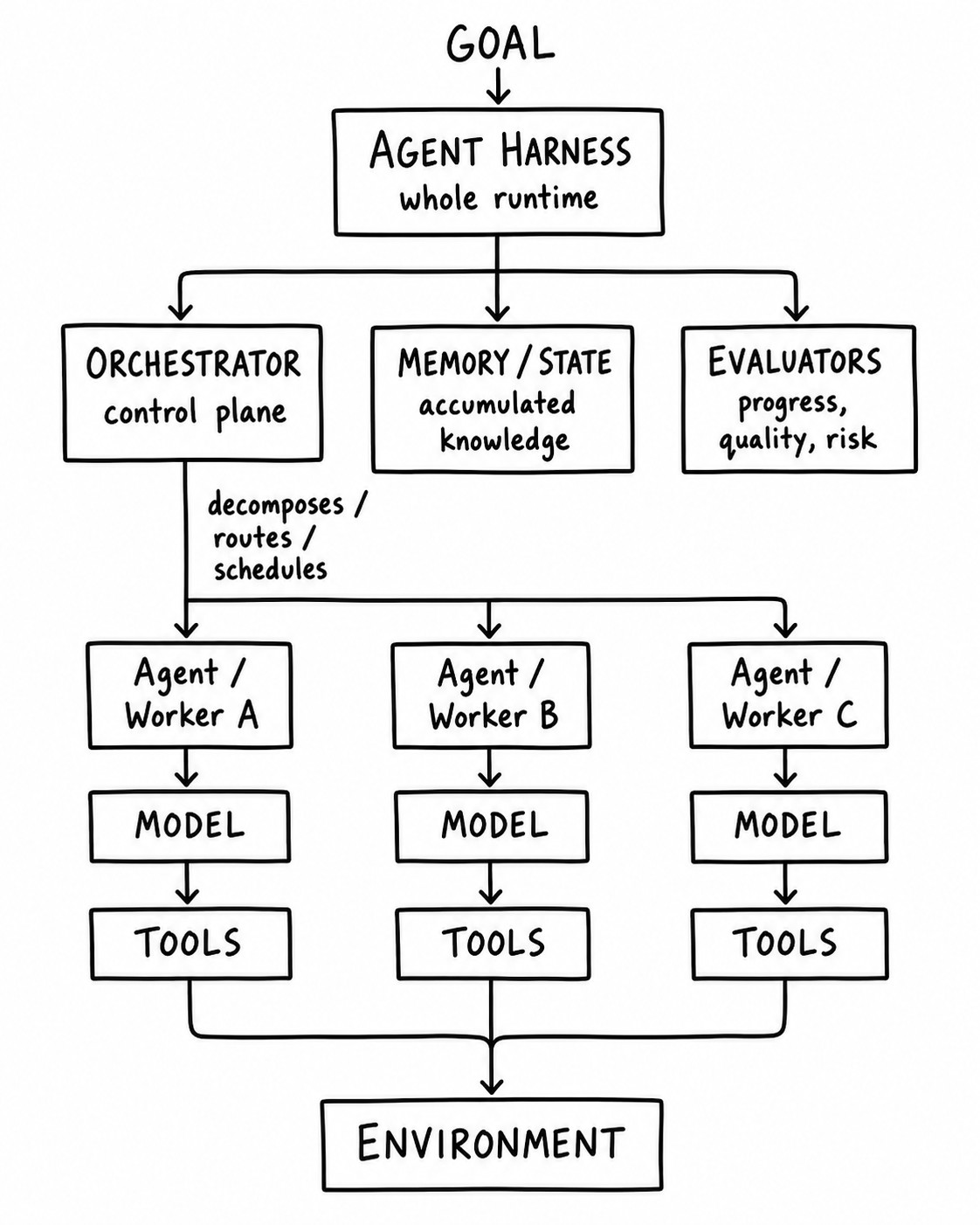
Rather than waiting for the next model to be able to solve the business problem, the focus should shift to today’s model (or even yesterday’s model) with the right tools and supporting infrastructure around it.